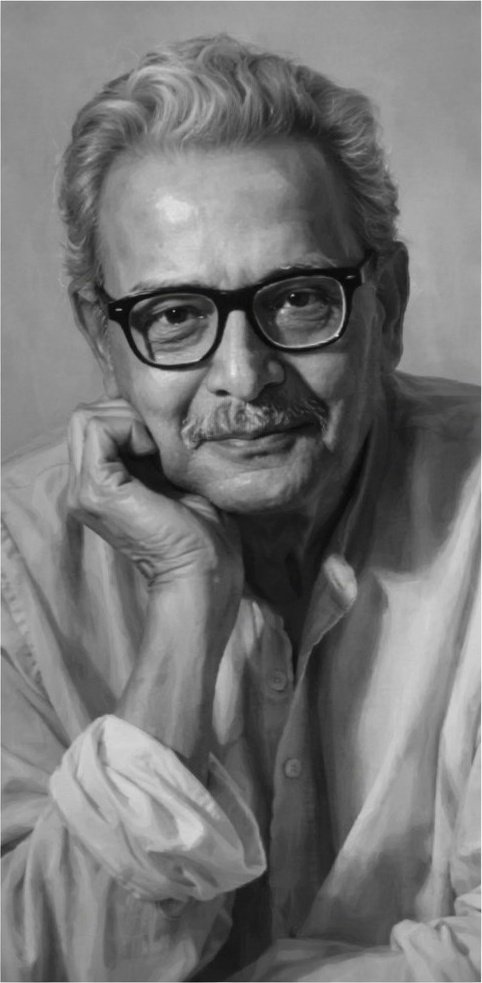
Shamsur Rahman Faruqi
Founder & Mentor · 1935 to 2020
One of the most celebrated writers in Urdu - poet, critic, translator and novelist - whose scholarship on the Dastan-e-Amir Hamza recovered the very tradition that Dastangoi revives.
About the Art
A single narrator, a bare platform, and nothing but the voice, conjuring an expansive, infinite world. This is the story of a tradition lost, and reborn.
The Art Form
The word Dastangoi refers to the art of storytelling, a compound of two Persian words, dastan and goi, which together mean to tell a Dastan.
Dastans were epics, oral in nature, recited or read aloud, in essence the medieval romances of the Persianate and Urdu speaking world. Telling tales of adventure, magic and warfare, they mapped new worlds and horizons, encountered the unseen, and carried the hero through countless travails and loves as he moved on his quest. Sometimes that quest paralleled the mystic search; at other times it told a purely worldly tale.
In the telling, narrators freely borrowed tropes and themes from one another, which is how Rumi's Masnavi and the Arabian Nights alike came to hold stories from the Panchtantra. There were many Dastans and many heroes, but one cycle stood out early and never lost its place: the story of Hamza.
 Dastan-e-Amir Hamza
The Hero of Heroes
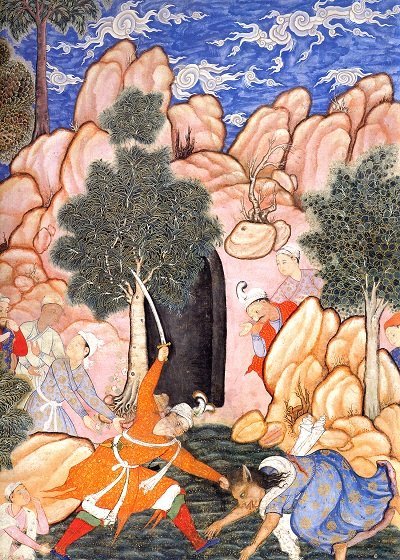
Beginning with an unknown Arabic version, the Persian retellings followed the life of Amir Hamza, said to be an uncle of the Prophet Mohammed. Marked out from birth by fairies, djinns and prophecies, Hamza travels to distant lands and, even as a young child, shows great prowess and daring.
Summoned by the chief minister of the King of Persia to aid him in his troubles, Hamza meets adventure after adventure, crossing strange realms and stranger beings, and remains triumphant and unvanquished to the very end.
In the Mughal Court
By the sixteenth century, versions of the Hamza story were circulating in India. First mentioned in the Deccan courts, the narrative reached its artistic apogee under Emperor Akbar, by which time specialised tellers, the Dastangos, had emerged as a genre of their own. Akbar was exceedingly fond of the tale and would recite it himself.
One of the first artistic projects he commissioned was an illustrated Hamzanama: a mammoth undertaking of over 1,200 folios, each at least a yard and a half by a yard, with the text inscribed on the back. Nothing of that scale was attempted again by the Mughals. Some scholars suspect the great panels were a kind of audio-visual aid, a teller narrating from behind while the images changed with the story, a sort of proto-television.
Into Urdu, Into Print
The first Urdu version appeared early in the nineteenth century under the Fort William College in Calcutta, the East India Company institution that first edited and published key texts of the North Indian literary tradition. Alongside the Dastan-e-Amir Hamza it issued Mir Amman's Bagh-o-Bahar, reprinted over twenty times and still taught today.
When print reached North India in the mid nineteenth century, stories, fables and Dastans became its great engine, second only to religious literature. Yet in Urdu the Hamza tradition still thrived as oral performance more than as a printed commodity. At Rampur and Lucknow, tellers were committing it to paper, but in manuscript, and the stories were already swelling, growing from a single Persian volume into many, with whole new territories of trickery and of magical, wondrous worlds unlike anything in Persian literature.
A Living Performance Culture
By the mid nineteenth century Dastangoi was firmly entrenched across northern India. In Sir Syed Ahmed Khan's account of Delhi, Asar-us-Sanadid, the Dastangos appear prominently, gathering every Thursday on the steps of the Jama Masjid to recite their tales. Mirza Ghalib was so fond of the Hamza Dastan that for two years he held weekly sessions at his house; once, writing to a friend, he reported that it was raining and he had just acquired "six chapters of the Hamza dastan and sixteen casks of wine, what more do I want from life."
The upheaval of 1857 sent thousands of artists, poets and Dastangos from Delhi to Lucknow. The city's first historian, Abdul Halim Sharar, described how every nobleman came to keep a Dastango in his retinue, and how the chowks became favoured sites of performance. He called the art "extemporaneous composition," resting on the description of four things: war, romance, trickery and magical artifice. These tellers were not reciting from memory; they were improvising upon bare structures handed down to them.
The Crowning Glory
In 1881, the legendary Lucknow publisher Munshi Nawal Kishore set the leading Dastangos of the city to a singular task: to set down the entire Hamza narrative as it lived in oral and written record. The core team, Mohammed Husain Jah, Ahmed Husain Qamar and Sheikh Tasadduq Husain, later joined by others, laboured for twenty-five years.
The result was a series of forty-six enormous volumes, each about a thousand pages. Each could be read on its own or as part of the whole. The expansion from a single volume to this mammoth cycle was largely the work of the performative tradition, the body of the story supplied by the teller as he recited, resting at most on slim key-books that outlined the characters and the run of the plot.
It is the summit of a thousand years of Indo-Islamic storytelling: thousands of invented names, weapons, beings and realms, an overflowing vocabulary, a virtuosity of metaphor and simile. The fantastic is grounded in the real, so the cycle reads at once as wild invention and as a remarkable social document of the pre-colonial order, appealing to high and unlettered audiences alike.
Voice Alone
Where the Hamza story was sung elsewhere in the Islamicate world, from Morocco to Indonesia, often to musical accompaniment, the Indian Dastangos relied purely on words and the art of narration. A single performance demanded a rare command of rhetoric, delivery, mimicry, ventriloquism and spontaneous composition, holding a restless public audience that could drift away at the slightest drop in intensity.
The last of the great traditional tellers was Mir Baqar Ali, who died in Delhi in 1928, just a few years before sound transformed Indian cinema. By all accounts he was perhaps the last great traditional actor this country produced.
He never told dastans, he presented lively, moving pictures; or rather you could say that he himself became a picture. He was a thin, slightly built man, but while he was reciting, if a king appeared in the story, the listeners felt themselves standing before an imperious monarch.
The Long Silence
At the close of the nineteenth century, a generation of reformers recast Urdu's literary values, looking down on what they called the "artificial and conceited" works of the past. Yoking literature to social reform and prizing simplicity and truthful experience over invention, and mirroring Victorian tastes, they made the realist novel the only permissible form of fiction. The Dastan was its very opposite, an anti-novel, and was dismissed as childish, inconsistent, implausible and too repetitive.
Religious censure had already warned readers, women especially, away from the Dastans; colonial officers thought them immoral. As cinema absorbed many of their conventions and the oral culture that produced them gave way to a literary one, the form faded from both the literary canon and the performing arts. Today the complete forty-six volume set survives in only one collection in the world, and the Dastan-e-Amir Hamza has all but vanished from public memory, the very loss that the revival, decades later, set out to answer.
2005 - A Silence Broken
For nearly eight decades after Mir Baqar Ali's death in 1928, the living chain of Dastangoi was broken. What survived did so on the page, above all in the scholarship of Shamsur Rahman Faruqi, whose multi-volume study of the Dastan-e-Amir Hamza, Saheri, Shahi, Sahibqirani, recovered the tradition and its techniques in extraordinary depth.
Around the year 2000, the writer and director Mahmood Farooqui read Faruqi's work and was seized by it. After years of reading and research, and with Faruqi's encouragement and mentorship, he staged the first modern Dastangoi performance in 2005, with Anusha Rizvi, reviving an art that had been all but silent for a lifetime.
From One Night to a Movement
What began as a single experiment before a small audience grew quickly into a full movement. Joined early on by the actor Danish Husain, Farooqui began to perform widely and, just as importantly, to teach, re-establishing the master-to-pupil apprenticeship that had once kept the tradition alive.
Two decades on, more than fifty Dastangos have been trained, over a thousand performances have been staged across India and the world, and a new repertoire of some fifteen modern Dastans has been written for the stage.
What Revival Required
As Faruqi observed, the return of Dastangoi needed two things to meet at once: someone who knew the Dastan thoroughly and loved it, and someone fluent enough in Urdu, and steeped enough in its classical literature, to perform it dramatically before a modern audience.
It is a high bar. Authentic Dastangoi, Farooqui insists, cannot simply drape traditional dress over thin material; its substance, language and structure must themselves carry the elevation, the linguistic richness and the depth that earn the name.
The New Canon
Beyond the classical Hamza cycle, the revival has written an entirely new body of work, carrying the form to urgent, present-day concerns and to stories drawn from far beyond its origins.
Dastan-e-Taqseem-e-Hind
The Partition of India
Dastan-e-Sedition
Dissent and the law
Dastan-e-Chauboli
A Rajasthani folk tale, after Vijaydan Detha
Dastan-e-Karn
Karn's tale, from the Mahabharata
Ghare-Baire
After Rabindranath Tagore
Alice & The Little Prince
World classics, retold in Urdu
Pesh-e-Lafz · The Forewords
The narrative technique of the Dastan is so powerful and compelling that it rises above fashion and the temporary concerns of an age, reviving sensibilities innate to us all.
Shamsur Rahman Faruqi
Founder & Mentor
In August 2002, I had my first encounter with the Dastan-e-Amir Hamza. I knew nothing of Dastangoi then, only that here was a world I had to find a way to bring back to life.
Mahmood Farooqui
Creator & Director
The People
The mentor, the maker and the producer behind a tradition reborn.
Founder & Mentor · 1935 to 2020
One of the most celebrated writers in Urdu - poet, critic, translator and novelist - whose scholarship on the Dastan-e-Amir Hamza recovered the very tradition that Dastangoi revives.
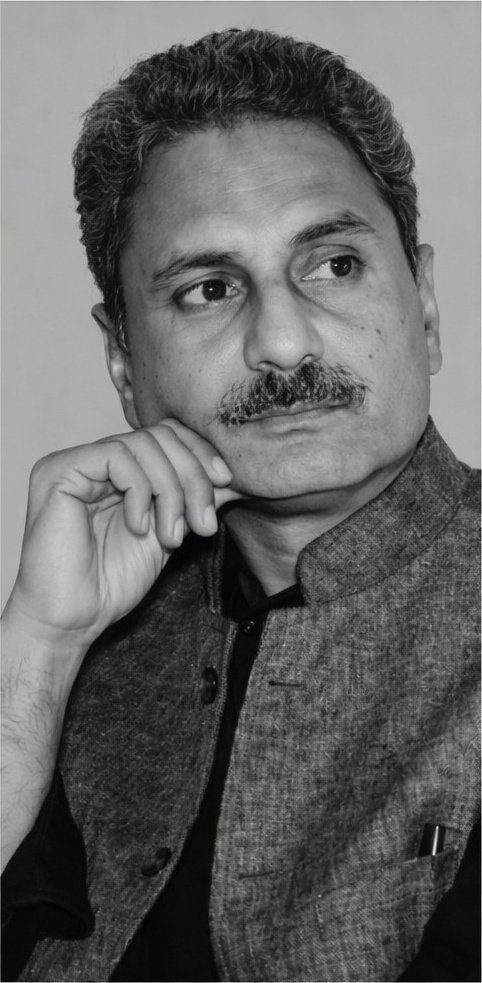
Creator & Director
Award-winning writer, Rhodes Scholar and Dastango. He spearheaded the revival of Dastangoi in 2005 and has since performed thousands of shows around the world.
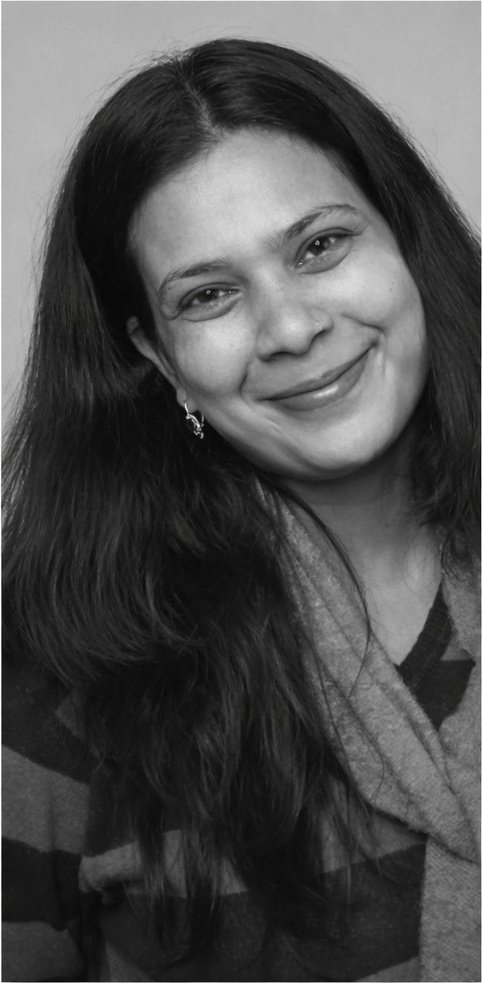
Producer
A Delhi-based writer and film director, and a former NDTV journalist. Her directorial debut, the satire Peepli Live, premiered at the Sundance Film Festival in 2010.
Questions
It is a compound of two Persian words, dastan (a tale or epic romance) and goi (the telling of it). Dastangoi is, simply, the art of telling a Dastan.
A Dastan is a long-form epic of adventure, magic and warfare. The greatest of them all is the Dastan-e-Amir Hamza, a cycle so vast it was eventually printed in forty-six volumes of around a thousand pages each, encompassing the trickster Amar Ayyar and the enchanted world of Tilism-e-Hoshruba.
Traditionally one or two narrators sit on a bare platform, dressed simply, with no sets, props or musical accompaniment. Everything is built from voice, language and gesture alone: vocal modulation, mimicry and rhetorical command conjure every character and scene.
The writer and director Mahmood Farooqui staged the first modern performance in 2005, encouraged and mentored by the Urdu critic Shamsur Rahman Faruqi. The art had been effectively silent since the death of the last classical Dastango, Mir Baqar Ali, in 1928.
The classical Dastans are performed in a rich, Persianised Urdu, while many modern Dastans use a more contemporary idiom and draw on Hindi and even English. Audiences without Urdu regularly find themselves fully drawn in; the music of the voice, the timing and the gesture carry the story as much as the words.
Yes. The collective performs across India and abroad and trains new tellers through workshops and apprenticeship. Reach out via the contact page to enquire about a show or a workshop.
Bring a living tradition of storytelling to your stage, festival or gathering.
Book a Performance